
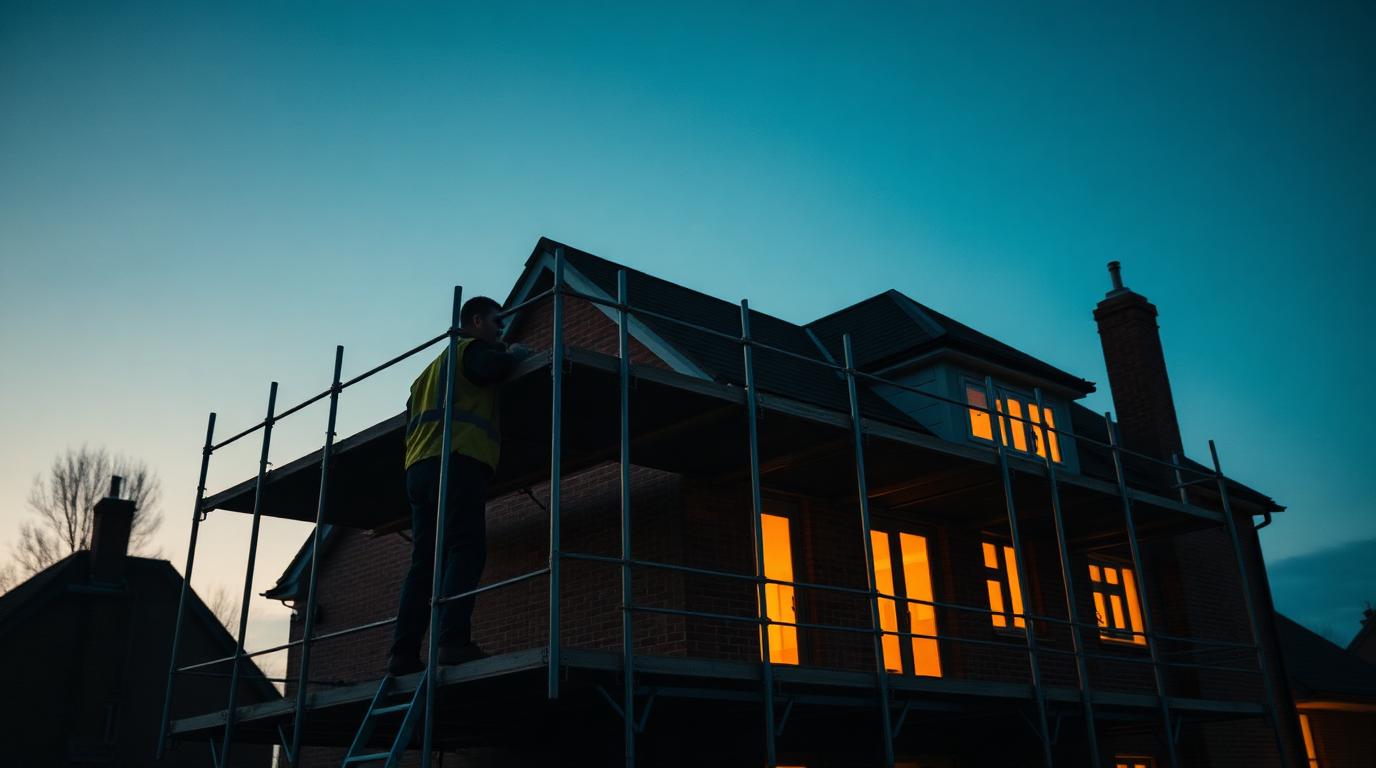
Building work is one of the highest-ticket service categories in the UK. A single-storey extension in London or the South East can be worth £45,000–£90,000. A loft conversion sits between £35,000 and £75,000. A full renovation can pass £150,000. Google Ads puts your building company in front of homeowners the moment they start planning those projects — and if the account is built properly, one converted lead can pay for a year of advertising.
This guide is written for UK builders, construction firms and small-to-mid main contractors who want a practical, profitable approach to Google Ads. It covers campaign structure, keyword selection, negatives, ad copy, landing pages, budgets and call tracking — with a focus on the jobs that actually pay: extensions, loft conversions, renovations, refurbishments and new builds.
Why Google Ads works for builders
Homeowners planning an extension or loft conversion rarely start on social media. They start on Google. They search "extension builders near me", "loft conversion cost" or "house renovation company [town]", read a handful of local sites and shortlist two or three firms to quote. Google Ads lets you appear at the top of that shortlist — and to be the first to answer the phone.
- Very high ticket sizes. Extensions, lofts and full renovations regularly clear £40,000–£150,000. Even a modest lead-to-job rate produces exceptional returns.
- Low competition on marketing-specific terms. "Marketing for builders" (170/mo) and "marketing for construction companies" (390/mo) show that most UK builders still rely on referrals — a well-run Google Ads account is a real advantage.
- Local, planned intent. Homeowners search for local builders when they have already decided to invest. You are not creating demand — you are capturing it.
The builders who win with Google Ads treat it as a system: the right ad, matched to the right landing page, with a fast phone response and a proper follow-up. A homeowner planning a £70,000 extension is not choosing on price alone — they are choosing on trust, portfolio and process. Your ad and landing page have to convey all three inside 30 seconds.
Campaign structure that scales
The biggest mistake in builder ads is running a single "builders" campaign that tries to cover everything. Extensions, loft conversions, kitchens, bathrooms and new builds attract very different customers with different budgets and timelines. Merge them and your ads become generic — and generic loses to specialist competitors.
Recommended campaign split
- House extensions — single-storey, double-storey, side return, wrap-around.
- Loft conversions — dormer, hip-to-gable, mansard, Velux.
- Full renovations and refurbishments — whole-house projects.
- Kitchen and bathroom refits — smaller ticket, faster decision cycle.
- Garage conversions and outbuildings — annexes, garden rooms, home offices.
- New builds — self-build clients and one-off homes.
- Commercial fit-out and refurbishment — a separate audience with separate messaging.
Ad group structure
Inside each campaign, keep ad groups tightly themed. For example, inside a "House extensions" campaign you might have:
- House extension builders (generic)
- Single storey extension
- Double storey extension
- Side return extension
- Extension cost
Tight themes let you write ads and landing pages that mirror the exact search term. Quality Score rises, cost-per-click falls, and the customer feels like the page was made for them.
Keywords for high-ticket building work
Keyword selection decides whether your builder ads attract serious homeowners or endless "how much does…" researchers. Focus on commercial, service-based intent — the phrases a person types when they are actively looking to hire.
Service-specific keyword themes
- Extensions: "extension builders near me", "single storey extension builders", "double storey extension cost", "side return extension [town]", "kitchen extension builders".
- Loft conversions: "loft conversion company", "dormer loft conversion", "loft conversion cost", "loft conversion specialists [town]", "hip to gable loft conversion".
- Renovations: "house renovation company", "full house refurbishment", "period property renovation", "victorian house renovation builder".
- Kitchens and bathrooms: "kitchen fitters near me", "bathroom renovation company", "kitchen refit builders".
- Specialist: "garage conversion builder", "garden room builders", "annexe builder", "self build contractor".
Match types to use
Start with phrase match and exact match. These give you control over which searches trigger your ads. Broad match on a term like "builder" or "extension" will pull in every irrelevant search on Google — from "lego builder" to "muscle builder" — and drain budget fast.
Local intent
Set location targeting at the campaign level with a realistic radius around the areas you actually work. Extensions and lofts are local jobs — a homeowner in Guildford will not hire a Manchester builder. A 20–30 mile radius around your base, refined by postcode, is cleaner and more scalable than stuffing every town name into your keyword list.
Negative keywords that protect budget
Negative keywords are the fastest way to improve ROI on builder ads. They stop your ads showing for searches that will never become a booked project. Build a strong starter list before launch and review the search terms report every week.
Universal negatives for builders
- jobs, apprenticeship, salary, career, labourer, cscs, hiring
- course, training, nvq, qualification, exam, college
- DIY, how to, tutorial, youtube, video, guide
- free, cheap, cheapest, gumtree, bargain
- materials, timber, bricks, cement, screwfix, wickes, b&q, jewson, travis perkins
- software, cad, plan, drawing (unless you offer design)
- lego, minecraft, roblox, muscle, body, career builder
- architect, planning consultant, structural engineer (unless you offer these)
Location negatives
If you only serve a specific region, add major UK cities outside your area as negatives. A Kent-based builder should exclude London, Birmingham, Manchester, Bristol, Leeds and Glasgow from generic campaigns. This alone can cut wasted spend by 20–40%.
Budget-signal negatives
Consider excluding terms like "cheapest builder", "budget extension" or "cash job" if you position at the mid-to-premium end of the market. You want serious clients with realistic budgets, not price shoppers looking for corners to cut.
Ad copy that earns the click
Homeowners hiring a builder are nervous. They have heard the horror stories — jobs abandoned mid-project, budgets doubling, quality falling apart within a year. Your ad copy has one job: reduce that fear in the first three seconds. Clever headlines matter less than clear proof.
Elements every builder ad should include
- Specialisation: "Extension & Loft Specialists in Surrey", "House Renovation Experts — Kent & Sussex".
- Coverage: "Serving West London & Surrey", "20+ years across the South East".
- Credentials: "FMB member", "TrustMark registered", "Fully insured", "£5m public liability", "10-year insurance-backed guarantee".
- Process: "Free design consultation", "Fixed-price quotes", "Project managed from planning to completion".
- Social proof: "150+ completed projects", "Rated 4.9 on Google", "As featured in Houzz".
- Clear CTA: "Book a free site visit", "Get a fixed-price quote".
Use every relevant ad extension
Extensions make your ad bigger and improve click-through rate at no extra cost. For builders, enable:
- Call assets with tracked numbers and business-hours scheduling.
- Location assets linked to your Google Business Profile.
- Sitelinks for extensions, loft conversions, renovations, portfolio and reviews.
- Callouts for FMB member, insurance-backed guarantee, free consultation, fixed-price quotes.
- Structured snippets listing services: extensions, loft conversions, kitchens, bathrooms, renovations, new builds.
Test multiple angles
Create at least two responsive search ads per ad group with different value propositions. Test credibility versus process versus portfolio. Google will optimise toward the strongest version, but it needs meaningful variation to learn from.
Landing pages that convert
Sending building-work traffic to your homepage is one of the most expensive mistakes in the category. A dedicated landing page matched to the ad — one for extensions, one for loft conversions, one for renovations — can double or triple conversion rates. Homeowners investing tens of thousands need proof, not a generic brochure page.
Anatomy of a high-converting builder landing page
- Above the fold: headline matching the ad (e.g. "House Extensions in Guildford — Fixed-Price Quotes in 7 Days"), phone number and short enquiry form.
- Trust bar: FMB / TrustMark / CheckaTrade logos, review score, years trading, insurance details, guarantee length.
- Portfolio: real before-and-after photos of completed local projects. Building work is visual — proof sells.
- Process: a clear step-by-step (consultation, design, quote, build, completion) that removes uncertainty.
- Pricing indication: typical ranges by project type. Homeowners qualify themselves and time-wasters drop off.
- Case studies: two or three detailed local projects with photos, brief, timeline and outcome.
- Reviews: specific, dated Google reviews naming local towns and project types.
- Coverage: a clear list of towns, postcodes or counties you serve.
- Sticky CTA: click-to-call button pinned to the bottom of mobile screens.
Mobile and speed
Most builder enquiries start on mobile — often on an evening or weekend when the homeowner is finally sitting down to plan. Keep the page fast, the form short, and the phone number impossible to miss. Aim for a Largest Contentful Paint under 2.5 seconds and a form with no more than name, phone, postcode and a short project description.
Budget and bidding for UK builders
There is no single correct budget for builder ads. The right number depends on your area, your services and your margins. A better approach is to work backwards from the value of a converted job.
Simple economics
A single-storey extension can be worth £45,000–£90,000. A loft conversion sits between £35,000 and £75,000. A full renovation can pass £150,000. If one in six or seven enquiries becomes a booked project, you can afford a cost-per-lead of £150–£350 and still be very profitable. Well-managed builder campaigns typically run at £80–£250 per qualified enquiry depending on region, with London and the South East at the higher end.
Bidding strategy
- Manual CPC or Maximise Clicks for the first three to six weeks while you gather data. Builder sales cycles are longer than trades, so give the account time.
- Maximise Conversions or Target CPA once you have 20–40 recorded conversions in the account.
- Avoid Maximise Conversion Value unless you are feeding accurate lead values back into Google via offline conversion imports.
Scheduling
Run ads only during hours you can answer the phone or respond to a form within 30 minutes. For builders, evenings and weekends are often the strongest windows — homeowners plan projects outside work hours. Test day-parting once you have four to six weeks of data.
Tracking calls and enquiries
Without conversion tracking, builder ads are guesswork. The sales cycle is long, ticket sizes vary massively, and one great lead can outweigh 20 poor ones. Call tracking and offline conversion imports are essential to see which keywords and ads are actually producing booked projects.
Track everything that matters
- Phone calls from ads using Google's call-forwarding number or a dedicated call tracking platform.
- Phone calls from your website after an ad click (dynamic number insertion).
- Form submissions as a separate conversion action in Google Ads.
- Site visit and quote bookings if you use online scheduling.
Feed lead quality back into Google
Not every enquiry is equal. Once you know which leads turned into booked projects — and which turned into £70,000 extensions versus £8,000 bathroom refits — upload offline conversions back into Google Ads. This teaches the algorithm to find more high-value clients: homeowners with planning permission already in place, listed property owners, and clients with realistic budgets.
Review search terms weekly
The search terms report is your most valuable source of optimisation ideas. Every week, add irrelevant queries as negative keywords and promote high-converting queries into their own exact-match ad groups. This one habit separates accounts that improve from accounts that drift.
Google Ads management for builders
Setting an account up is a one-off job. Managing it is what decides whether the cost per enquiry falls or climbs, and it is the part most builders underestimate. An account left alone for a few months almost always drifts: search terms broaden, competitors change their bids, and budget quietly leaks into jobs you never wanted.
What ongoing management actually involves
Week to week, management means reading the search terms report and adding negatives, promoting the queries that produced real enquiries into their own tightly matched ad groups, adjusting bids by location and time of day, refreshing ad copy that has stopped earning clicks, and checking that call tracking and form conversions are still firing correctly. Month to month it means reviewing cost per enquiry by service — extensions behave very differently from garage conversions — and shifting budget toward whichever campaigns are booking work.
How budgets are set for a building firm
Work backwards from the job, not from a round number. Decide how many extra projects you can realistically deliver in a quarter, estimate how many enquiries you need to win one, and multiply by what an enquiry is costing you. For high-value building work a smaller budget spent on a narrow set of high-intent keywords in the towns you actually serve consistently outperforms a bigger budget spread thinly across broad match.
In-house or managed
Running it yourself is entirely possible if you can give it a couple of focused hours each week and you are comfortable reading the data. Most builders cannot, and the account suffers during the busy months — exactly when it is spending most. If you would rather it were handled, see Google Ads management for builders and UK trades, pair it with landing pages built to convert paid traffic, and read SEO for builders for the organic side that reduces your reliance on paid clicks over time.
The bottom line
Google Ads is one of the most effective ways to generate high-value building leads in the UK — but only when the account is built around real customer intent. Structure campaigns by service, choose high-intent keywords, protect budget with negatives, write reassuring ad copy, send traffic to dedicated landing pages and track every call. Do that consistently and builder ads become a reliable pipeline of extensions, loft conversions and renovation projects.
If you would rather have this managed for you, the Leadzig Growth System builds Google Ads, landing pages and call tracking specifically for UK builders and construction companies. We handle the strategy, build and ongoing optimisation so you can focus on the projects themselves.
Book a free consultation and we will map out your account structure, keywords and landing pages.
Related guides
View all guidesSEO for Trades: The Practical Guide to More Calls from Google
Our pillar guide — Google Business Profile, local keywords, service pages and turning search into calls.
Read guideSEO for Builders: Win Extension Leads
Attract extension, loft conversion and renovation enquiries through organic search.
Read guideConstruction SEO: A Guide for UK Contractors
Scale search visibility for mid-to-large construction firms — project pages, sectors and regional authority.
Read guideGoogle Ads for Roofers: Win High-Value UK Jobs
Bring in emergency and replacement roofing enquiries with tightly targeted paid search.
Read guide